Exhibitor Press Releases
22 Jan 2026
Essential Lighting for Critical Spaces - Setting Revolutionary Standards in Data Centre Lighting
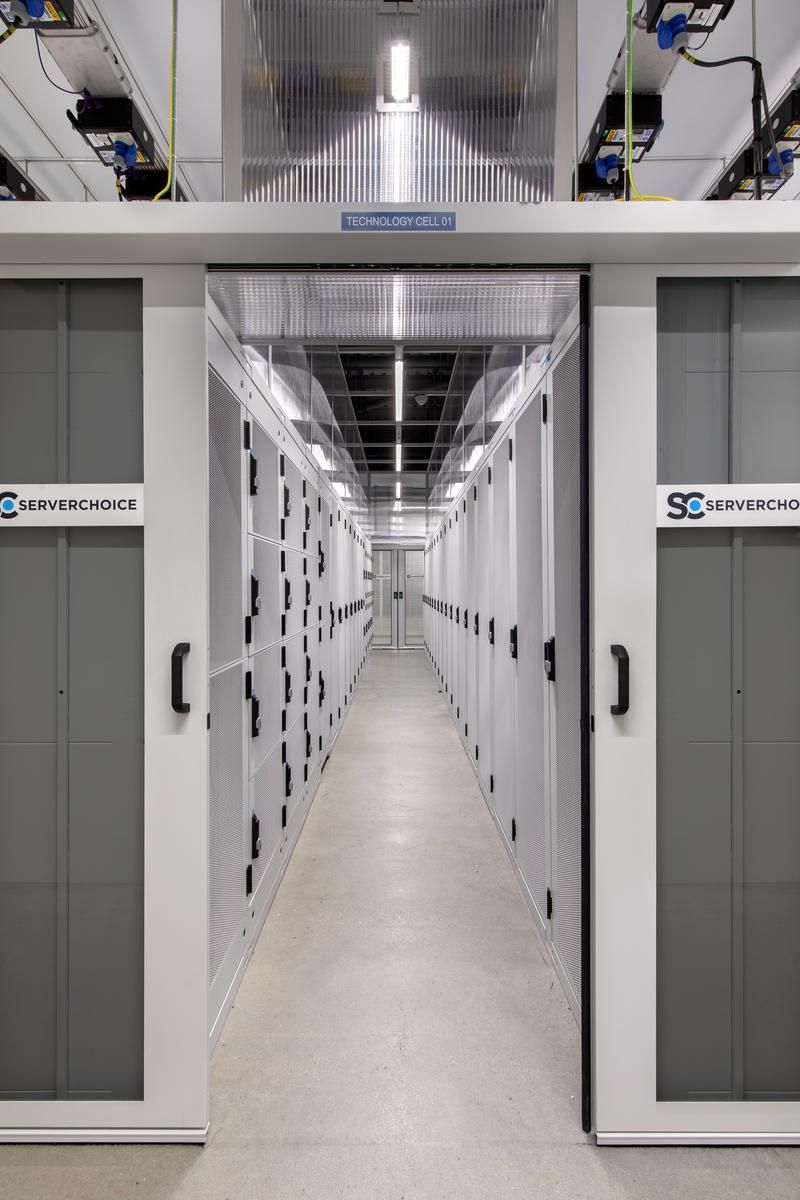
We consider the critical aspects that need to be addressed in the design and implementation of data centre lighting.
Innovative, Sustainable and Secure
Safe, reliable operation and energy efficiency are two of the biggest challenges presented by the increasing demand for data centres worldwide. However, Internet users are largely unaware of how many resources these centres consume and the vulnerability of this global, omnipresent digital service – unlike hardware, your personal, invisible data traffic and the data clouds are intangible.
Data centres use more than 1% of the world’s electricity, due at least in part to additional Internet use during the lockdown phase in spring 2020 (+ 40%), for example. Despite a doubling in user numbers since 2010, the increase in power consumption has been more gradual, thanks to improved technologies (source: IEA Report Data Center).
The PUE (power usage effectiveness) metric, which determines the ratio between the total power consumption of a data centre and that of its actual digital infrastructure, is an important quality factor in this positive development.
An efficient lighting solution will take this metric into account. The right combination of luminaires and controls, optimised service intervals or service packages and monitoring ensures continuous, fault-free operation. However, light also supports people in their daily work and in extreme situations such as during a cyber blackout, which is now just as media-relevant as a large-scale power failure.
Sustainability and Energy Efficiency
Efficiency and sustainability are key challenges for data centre operators. The percentage of tot al energy consumption used for lighting is only in the single digits. In purely mathematical terms, this figure may appear low at first glance. Nevertheless, when it comes to the ideal PUE value, no stone should be left unturned in the effort to increase energy efficiency. This key figure should be as close to a value of 1.0 as possible. To achieve this, lighting has a role to play.
Zumtobel is dedicated to the ongoing development of technologies for luminaires, lighting controls and digital services. This means that we can provide pvery sustainable lighting solutions for our customers. Sustainability has long been a key focus for Zumtobel. Right from the initial development stage, certain essential criteria are factored into the product design and choice of materials. Today, the company’s core methods are based on environmental performance evaluations and the principle of the circular economy. Zumtobel was the first supplier in the lighting industry to offer independent environmental data about its products available in a systematic way – around a decade ago. Environmental Product Declarations (EPDs) are available to download for the main product types. These contain independently verified information about the products’ environmental credentials throughout their entire life cycle. This helps with measuring the carbon footprint of buildings and makes a contribution towards the Green Building certification process. At a company level, the Zumtobel Group has been awarded a gold medal for its achievements by the EcoVadis sustainability rating agency for the 4th time. This means that the Group belongs to the top three percent of over 75,000 companies evaluated. The next step on our path to achieving climate neutrality is to increase the proportion of renewable energies that we use by at least 50% compared to the benchmark year, 2015/2016.
Energy Efficiency Through Increased Reflectance
A maximum of energy saving is reached by integrating lighting management systems with presence and daylight linking control systems. Black server racks and other IT components absorb a lot of light, therefore hindering optimal light distribution in the data hall, as well as driving up power consumption (see image on the left). However, white devices reflect the light more effectively. Projections show that data centres with white equipment require 37% fewer luminaires, which in turn means a reduction in investment costs and power consumption (see image on the right).
Critical Infrastructure - Exacting Requirements
Data centres are considered critical infrastructure, making their reliable uninterrupted operation a top priority. High temperatures and the prevention of dust particle build-up therefore pose special challenges for the lighting. Principles of physics such as the Venturi effect and the Coandă effect are fundamental for our luminaire
construction to cool and clean itself.
Temperature Resistance
High temperatures caused by server operation in the data hall place extreme demands on the lighting. Temperatures on the processors can reach up to 80°C. This requires additional energy expenditure for ventilation and air conditioning for the devices and rooms. LED lights that have been specially developed and approved for extreme temperatures guarantee safe, efficient and cost-effective operation.
High Degree of Protection
The resistance of the luminaire surfaces facilitate the maintenance and cleaning processes. Whilst, IPX4 (ingress protection) enables the use of water based fire suppressions systems.
Light for People - Exceeding Standards
Light in data centres is more than a cost factor. Light contributes significantly to a conducive working environment. This involves not only the IT personnel being able to see data displays or labels but light also has an influence on emotional health as part of the ambience as well as on biological processes. Well-being, attentiveness and alertness are goals that make a valuable contribution to the working environment as part of the overall approach to light quality.
Visual Light Quality
Minimum standards for light in workplaces are set out in EN 12464-1 Lighting of workplaces – indoor workplaces. This standard also serves as a basis for planning. Key factors here are glare and illuminances with uniformity requirements in the task area. This is planned horizontally and vertically when working on the data centre servers. TECTON continuous-row lighting system and its incomparable split-lens technology ensure precise and efficient light distribution, whether symmetrical or asymmetrical, wide-beam or narrow-beam. Reduced glare means efficient and balanced light distribution on the horizontal surfaces or vertically in the racks.
Emotional Light Quality
Together with the room environment, light also supports people emotionally. Light takes on the task of specifically accentuating or punctuating tasks, objects and spaces. Considered design focused on cylindrical illuminance modelling enhances facial recognition, supporting video surveillance. The AMPHIBIA IP66 luminaire meets these demands due to its controlled light distribution. It creates a balanced lighting environment through the use of direct/indirect light.
Biological Light Quality
Data centres require 24 hour monitoring. Zumtobel’s SPECTRUM light source, can support control room employees with enhanced azure-blue wavelengths that mimic daylight. A study in a Bregenz Police control room showed that light is an essential factor in influencing whether workers in control room workplaces at night can efficiently carry out their tasks, remain alert and then return to a natural circadian rhythm.
Light for People - Exceeding the Standards
Zumtobel is not only a provider of general lighting, but also one of the largest emergency lighting manufacturers in Europe. We offer a comprehensive range of products that includes safety luminaires, escape-sign luminaires and emergency lighting systems. Lighting technology is our core competency. We develop technical lenses to achieve a variety of light distribution options for emergency lighting.
Safety Luminaires
Safety luminaires guide and support people in the event of power failure. A comprehensive range of specialist optics allows the emergency lighting design to be tailored to suit the exact building requirements. The light is guided precisely, e.g. in stairwells or in long corridors, where vulnerable junctions are given special consideration. RESCLITE PRO uses asymmetric lens technology to highlight safety-critical objects vertically, e.g. fire extinguishers and first aid stations. In the anti-panic variant, rooms are uniformly illuminated.
Escape Sign Luminaires
A versatile portfolio of escape- sign luminaires shows the way to the emergency exit in the appropriate luminance and sign size. Compliance requirements, environmental conditions and installation options, define the
type of the escape-sign luminaire due to its flexible mounting options and innovative ERI spot (escape route illumination). PURESIGN is recommended for data centres. Additionally integrated rotatable LED spotlights
meet the luminaire’s requirements for both signage and lighting in a dual function.
Emergency Escape Lighting Systems
The critical element of safety lighting are the batteries. We recommend distributed battery systems (EBOX), which supports maintenance and monitoring of the system. Removing the battery technology from areas
of higher ambient temperatures reduces total cost of ownership.
Learn more about our data centre lighting solutions and expertise on our website: